The Sirens' Song
Peterson had his Bösendorfer 290 Imperial personally selected, with serial number 34099
Those of us who’ve been into music for a few years now, with thousands of albums under our belts, tend to talk about music when we get together with fellow enthusiasts. We talk about albums, bands, songs… and if they’re also audiophiles, then about gear and gadgets. One question I’ve always asked my music-loving friends is to name their “perfect” albums. By “perfect” album, I mean one that you can listen to in one sitting without anything feeling out of place, and that you could listen to on repeat for hours and hours without getting bored. At first glance, this innocent question seems like it would get a long list of answers, but in reality, all my friends list only a very small number of albums, and curiously, we all agree on several of them. None of us can name more than ten or fifteen albums that fit into this category, even though we own collections of thousands of albums. This indicates two things: either we’re very professional and take our hobby very seriously, or it’s not easy for a band to make a perfect album. Well, the album I’m discussing today fits perfectly into that made-up category; it’s one of the “perfect” albums in my collection.
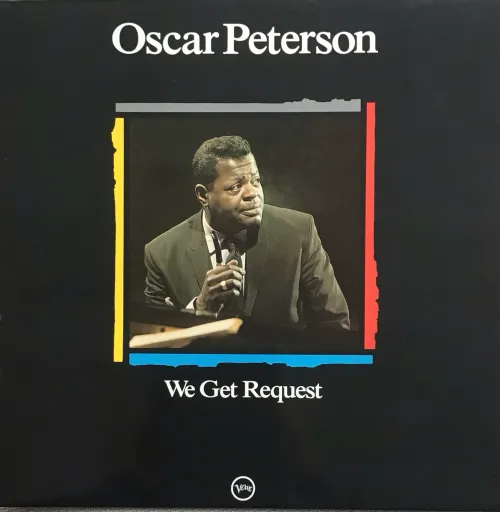
This album is part of the “Maestros del Jazz” newsstand collection that Planeta Agostini released in 1988. A vinyl record was released each week, which I reserved at a newsstand and faithfully picked up week after week for 100 weeks, as the collection consisted of 100 records with their corresponding 100 installments that could be bound into seven volumes. Today’s record was number 56 and was released in 1989. It was my first complete record collection, and I cherish it dearly. Previously, I had bought a few vinyl records from another collection, “Los Grandes del Jazz” from 1980, published by Sarpe (also on cassettes), without even owning a record player, so this passion of mine dates back to my youth. That series also consisted of 100 records with bindable booklets. Today I own a little over half of this collection, along with its four volumes of “La Gran enciclopedia del Jazz.”
Those were the days when you’d buy an album every week and had time to enjoy it until the following week, when the new album replaced the old one. Yes, there were several years of compulsive music buying. You reap what you sow.
Oscar Emmanuel Peterson was born in Montreal, Canada, on August 15, 1925. He began studying classical piano at age six, and at fourteen he won a competition for beginners, which earned him his first contract for a local radio show. At the age of nineteen, he was hired by Johnny Hodges, who led one of Canada’s most famous orchestras. With this group, he played for several years, combining this work—beginning in 1945—with that of his own trio and making his first recording. Between 1945 and 1949, he made twenty-eight more recordings, always with trios. Little by little, his fame spread beyond his country’s borders, and Jimmie Lucenfor and Count Basie offered him the chance to share the role of pianist in their orchestras. In 1949, Norman Granz heard him play at the Alberta Lounge in Montreal without much enthusiasm, but in the taxi on the way to the airport, he heard him perform live on a radio program and ordered the driver to turn back toward Montreal, hiring Peterson immediately and presenting him in September of that same year at Carnegie Hall in New York in a concert with “Jazz at the Philharmonic.” With this lineup, Peterson became famous worldwide thanks to his international tours. Great jazz musicians such as Roy Eldridge, Lester Young, Benny Carter, Barney Kessel, Ray Brown, Buddy Rich, and others passed through the group.
With Barney Kessel and Ray Brown, he formed a trio that lasted for several years; later, Barney Kessel was replaced by another guitarist, Herb Ellis, and when Ellis left, drummer Ed Thigpen joined, leaving the trio with piano, bass, and drums. This trio remained together for about five years, achieving absolute rapport and a sound that was both compact and natural.
In 1966, Ray Brown left the trio, and a succession of musicians joined the group—always well-chosen and of an excellent caliber. Notable among them was the lineup featuring bassist Niels Henning Orsted Pedersen and guitarist Joe Pass.
Peterson played and recorded with almost every major jazz musician; it would be easier to list those he didn’t play with than those he did. Gifted with an overwhelming technique, he has often been labeled a slave to it, but nothing could be further from the truth. He uses his technique to serve the music; few pianists can play at Peterson’s speed, deliver that overwhelming number of notes, and maintain that swing and musicality in every note. His left hand is prodigious, always hitting the perfect chord at the exact moment in such a subtle way that you aren’t aware of it until you pay attention, and in many of his recordings it truly seems as though there are two pianos—two hands for the right hand and another two for the left.
From here, I suggest a very nice exercise: during any piece you choose, follow his left hand, ignoring the entire melody played by his right hand, and you’ll be amazed by the amount of music he created with just one hand. This reminds me of an anecdote from the concert he gave at the Vitoria Jazz Festival in the summer of 1981. The Danish Consul in Bilbao, a passionate jazz expert, was sitting in the sixth or seventh row and said to his companions while Peterson wiped the sweat from his face with a handkerchief in the middle of the performance: “Look, it sounds the same whether he uses one hand or both.”
Starting in 1972, he began performing and recording as a solo artist, alternating this activity with various ensembles ranging from duos to sextets.
In 1993, he suffered a stroke from which it took him two years to recover; his left hand was permanently affected, forcing him to completely change his playing style, and although he continued to give concerts, nothing would ever be the same. Peterson died of kidney failure on December 23, 2007, at his home in Mississauga, Ontario, Canada.
Norman Granz (1918–2001) was an American producer, manager, businessman, and concert promoter of Jewish descent who changed the world of jazz forever and is responsible for the way we know jazz today. His personal story is the American Dream taken to the extreme. He met Peterson in 1949 and worked with him as a producer and manager until his retirement in 1988. Granz couldn’t sing a note and never learned to play an instrument, yet he made jazz possible in the 20th century.
He founded the Clef label in 1946, Norgan in 1953, and merged them with Verve in 1956. With Verve, he produced approximately 150 albums a year. In 1961, he sold his catalog to MGM for $2.5 million (about $25 million today) and remained inactive in the recording studios for twelve years. Currently, Verve also incorporates the catalogs of Mercury Records and EmArcy, all under the umbrella of the record giant Universal.
In 1973, he founded the record label Pablo Records, named in honor of his friend Picasso, with the company’s logo being an excerpt from one of the Malaga-born artist’s works. After releasing more than 350 albums, it was sold in 1987 to Fantasy Records, which retained the name Pablo and is now part of a conglomerate that includes Contemporary, Stax, Galaxy, Good Time Jazz, Prestige, Milestone, and Riverside Records, all under the Concord Music Group umbrella.
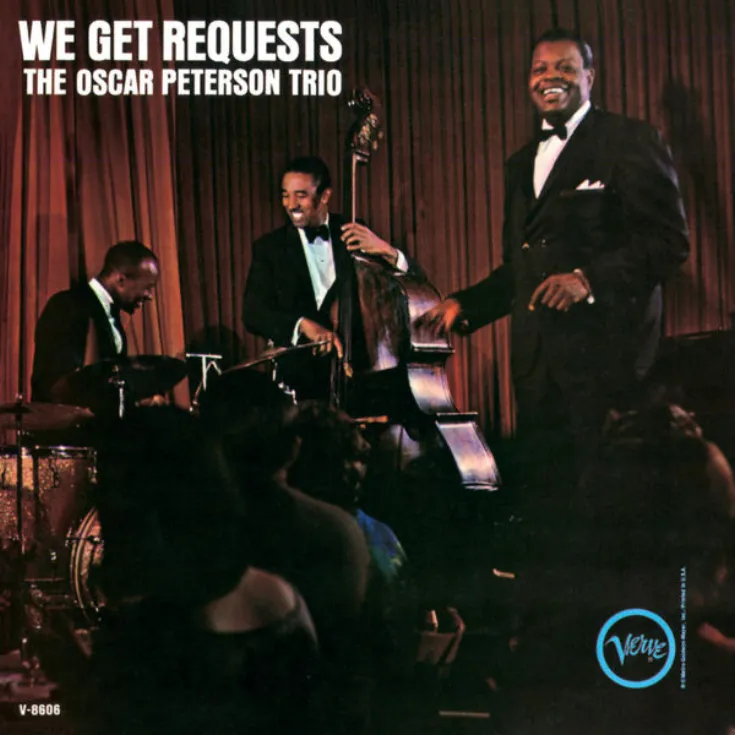
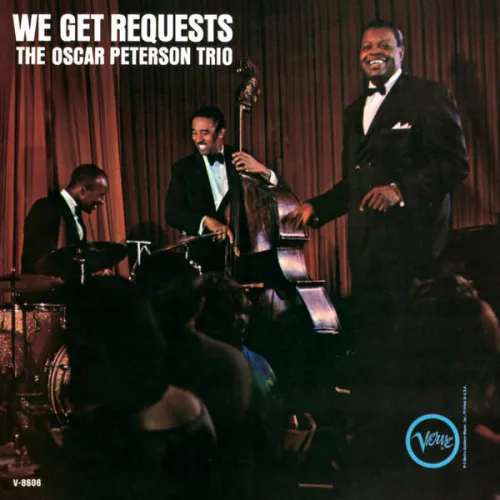
We Get Requests
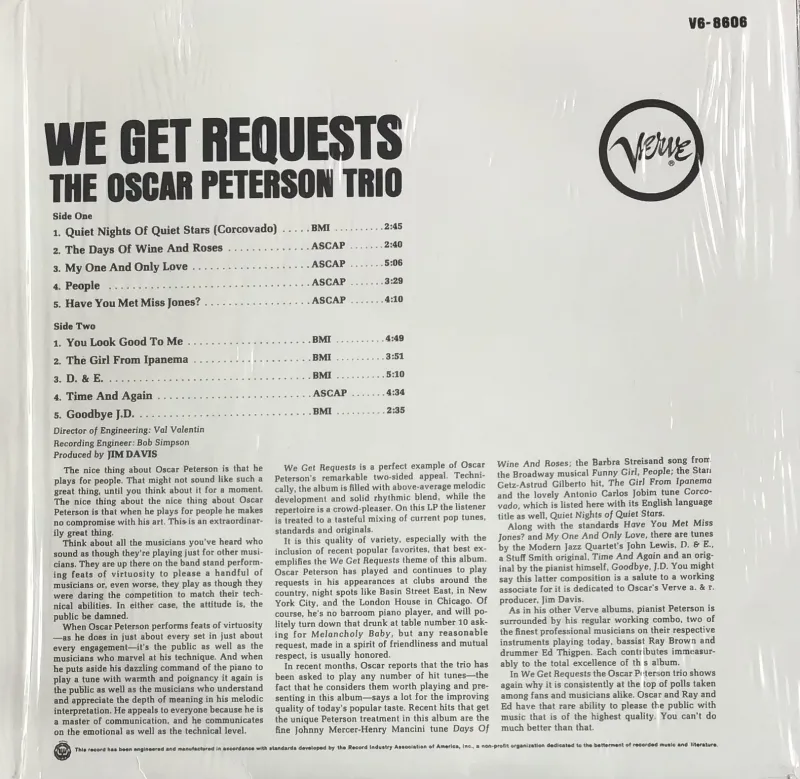
Recorded at RCA Studios in New York City on October 19 and 20 and November 19, 1964, with Jim Davis as producer and Oscar Peterson on piano, Ray Brown on double bass, and Ed Thigpen on drums.
With a runtime of 40 minutes of pure delight, it contains 10 wonderful tracks to listen to on repeat until you’re satisfied—all classics, except for the last one, which is a composition by Peterson and serves as a farewell to producer J. D.
It features two bossa nova tracks: “Corcovado,” which opens the album, and “The Girl from Ipanema.”
Good sound and good recording, just like they used to record back then: piano in the center, drums on the left channel, and double bass on the right channel, mainly. The recording would benefit greatly if the sound were better balanced, but the fact is that the trio played very close together live, with the drums behind Peterson’s stool and the double bass to the left of the pianist and the drums. Both Granz and Davis were obsessed with reproducing the live sound on the record. Perhaps this is the reason for the channel distribution.
I’ve used track 8, “D & E,” a lot to test equipment at listening sessions and industry trade shows.
The remastered digipack edition has a fantastic sound.
In 1961, Jim Davis replaced Norman Granz as Peterson’s producer. Davis had been hired occasionally by Granz to produce recordings in the late 1950s.
We Get Requests was the last album Peterson recorded for Verve after a fourteen-year contractual relationship.
The trio had been together for five years when this album was recorded and was at the height of its powers. It was recorded just as Peterson liked it: in one take, with the trio playing and recording the session—nothing more, nothing less. Doing a few more takes just to be safe and to take home. “All the takes on the album are complete and unedited, which was typical of the trio, and I don’t recall ever editing any track by the trio on any album I produced with Peterson,” says producer Jim Davis.
When the album was released in 1965, the prestigious jazz magazine Down Beat gave it a mixed review, and critic Don DeMichael awarded it four out of five possible stars. But this album has been in print for 30 consecutive years with steady sales, proving once again that critics and the public don’t always agree.
I could have chosen any other album from the twenty-five I own by Peterson, such as the delightful “Skol,” featuring the great Grapelli on violin; “Night Train,” the one most highly rated by critics; the absolutely essential “Ella & Louis”; or the award-winning and brilliant “Trio” with Joe Pass on guitar; but no, I’ve chosen “We Get Requests” because for me it’s not only Oscar Peterson’s best trio album and one of the best in his entire prolific discography, but also one of the best jazz trio albums I’ve ever heard—and, moreover, it’s one of the few “round” albums I own.
When Peterson played a Bösendorfer Concert Grand 290 Imperial piano during a concert in Vienna in 1970, he turned to his manager Norman Granz and said, “Damn it, Norman, I’ve got to have one of those!”
The history of this piano began in Vienna in 1900, when Ferruccio Busoni was transcribing J. S. Bach’s organ works for the piano and realized he needed lower notes to do justice to the sounds produced by the 16- to 32-foot pipes of an organ. Piano builder Ludwig Bösendorfer, son of Ignaz Bösendorfer, who founded the brand in 1828, took on the challenge and built the first prototype with a full 8-octave range.
The 290 Imperial has 97 keys (a full 8 octaves) instead of the 88 keys found on standard pianos. These additional, deeper bass notes resonate with every key played, and the massive soundboard allows for the projection of any frequency, giving this piano an orchestral sound.
It is constructed from air-dried Alpine spruce rather than kiln-dried, as is customary, to enhance its resonance. Each steel string is hand-wound with one or two layers of copper. The frame is manufactured using the traditional sand casting method. These raw frames rest for six months outside the factory to release all internal tension from the forging process, ensuring they are sufficiently relaxed to withstand the 20 tons of string tension.
When the drying process is added to the construction process, each 290 Imperial piano takes six years to complete. This sculptural marvel is available to anyone for the modest price of €243,000.
Peterson had his personally selected Bösendorfer 290 Imperial, serial number 34099, from 1970 until the end of his career, and it left his studio only three times.
In 2002, he received the Bösendorfer Lifetime Achievement Award following his performance at the brand’s 175th-anniversary concert.
Bösendorfer created the Oscar Peterson Signature Edition Grand piano, limiting production to 12 units in two sizes, 200 and 214 VC, featuring a collector’s edition plaque with Peterson’s logo and signature.
Peterson by the numbers
- 6.5 feet tall and 244 pounds.
- 4 wives and 5 children.
- Two massive hands with 10 fingers that seem like 3 hands and 15 fingers given the number of notes he can play at breakneck speed.
- Approximately 200 albums of his own recorded throughout his career.
- 8 Grammy Awards.


Make it yours forever
Buy this album in physical or digital format and support your favorite artists.
🛒 Buy now

The best music in Hi-Res
Enjoy uncompromising sound quality of this album.
Try it now