History of The Rising
Bruce Springsteen
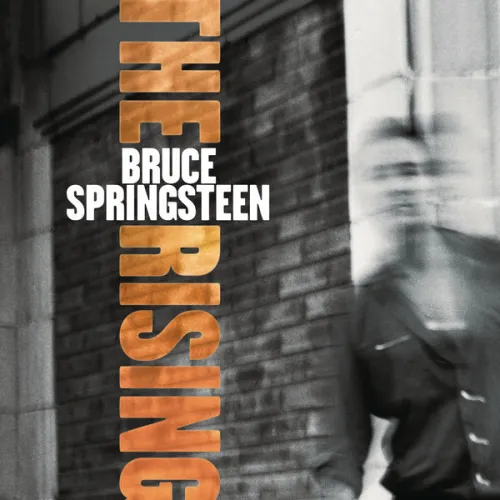
The Rising is Bruce Springsteen’s twelfth studio album, released on July 30, 2002, by Columbia Records. It was his first studio album in seven years and the first recorded with the E Street Band in eighteen years, following their reunion in the late 1990s. The album was conceived largely as an artistic response to the September 11, 2001, attacks, which deeply affected Springsteen and provided the thematic framework for many of the songs.
The album’s genesis is strongly linked to the emotional climate of American society following 9/11. According to biographical sources, a few days after the attacks, a stranger rolled down his car window as he passed Springsteen and said, “We need you now,” a phrase the musician interpreted as a call to return to writing from and for his community. Inspired by this, he began composing new songs that addressed grief, loss, faith, and resilience.
Recorded between January and March 2002, The Rising was produced by Brendan O’Brien, who brought a more contemporary and compact sound to Springsteen’s musical universe. The collaboration with O’Brien, which began with this album, marked the start of a period of joint work that would continue across several subsequent albums. The result is an album that combines the full-band rock of the E Street Band with choral arrangements, string sections, and elements of folk and gospel.
Thematically, the album addresses 9/11 from multiple angles. Many songs are told from the perspective of victims, survivors, family members, or witnesses, rather than through Springsteen’s own voice, which reinforces the choral nature of the work. The lyrics focus on the human experience of grief, loss, and the need to find meaning and hope amid the devastation, rather than on a political analysis of the events.
The title track, “The Rising,” was written specifically in response to the attacks. The song narrates, in the first person, a firefighter’s ascent up the stairs of one of the Twin Towers after the planes struck, blending images of sacrifice, smoke, and fire with spiritual and choral references that point to a transcendence beyond the tragedy. “The Rising” won Grammy Awards for Best Rock Song and Best Male Rock Vocal Performance, as well as a nomination for Song of the Year.
Other notable songs on the album include “Lonesome Day,” “You’re Missing,” “Into the Fire,” “Empty Sky,” and “My City of Ruins,” among many others. “You’re Missing” presents an intimate elegy centered on the home to which a missing person will never return; “Into the Fire” is a tribute to those who ran toward danger to help; “Empty Sky” expresses rage and grief at New York’s scarred skyline; while “My City of Ruins,” originally written about Asbury Park before 9/11, was reinterpreted as a prayer for a wounded city that must “rise up.”
The Rising was hailed as Springsteen’s triumphant return. Critics widely regarded it as his best work since the late 1980s, highlighting his ability to channel collective trauma into a narrative of grief and hope without succumbing to easy sentimentality. i magazine awarded it the highest rating (five stars), included it among the best albums of the decade, and later on its list of the 500 greatest albums of all time.
Commercially, the album debuted at number 1 on the Billboard 200, selling over 500,000 copies in its first week in the United States. It became Springsteen’s first album to top the U.S. charts since Tunnel of Love (1987) and strengthened his international presence by topping the charts in several countries. The accompanying tour, The Rising Tour, helped revitalize his fan base and confirmed the E Street Band’s relevance on the big stage.
The album won the Grammy for Best Rock Album in 2003 and was nominated for Album of the Year, though that award ultimately went to Norah Jones’s Come Away with Me. The combination of critical acclaim, commercial success, and historical significance has made The Rising one of the most important works of Bruce Springsteen’s career in the 21st century.
History of Bruce Springsteen
Bruce Springsteen was born on September 23, 1949, in Long Branch, New Jersey, and is an American singer-songwriter, guitarist, and bandleader known as “The Boss.” His work is characterized by a blend of rock, folk, and American roots music with lyrics that explore working-class life, the dreams, frustrations, and contradictions of the so-called “American Dream.” Throughout his career, he has alternated between full-band rock albums with the E Street Band and more intimate, acoustic works.
Springsteen began his career on the New Jersey club scene in the late 1960s and early 1970s, playing with various local bands before signing with Columbia Records. His first two studio albums, Greetings from Asbury Park, N.J. and The Wild, the Innocent & the E Street Shuffle (both from 1973), drew critical attention for their dense lyricism and blend of rock and soul, though they had only moderate commercial success. The big breakthrough came with Born to Run (1975), which catapulted him to fame thanks to songs like “Born to Run” itself.
In the second half of the 1970s and early 1980s, he solidified his status with albums such as Darkness on the Edge of Town (1978), The River (1980), and the acoustic Nebraska (1982). However, his greatest commercial success came with Born in the U.S.A. (1984), which became one of the best-selling albums in history, with seven Top 10 singles and a massive world tour. Despite the patriotic interpretation many gave to the title track, the song is actually a critique of the way the United States treated Vietnam veterans.
Following his success in the 1980s, Springsteen alternated between projects with and without the E Street Band. In the late 1980s and early 1990s, he released albums such as Tunnel of Love (1987)—more introspective and focused on personal relationships—and the solo albums Human Touch and Lucky Town (1992), as well as The Ghost of Tom Joad (1995), a folk-influenced and socially conscious album. In 1999, the official reunion with the E Street Band took place, leading to massive tours and, ultimately, the recording of The Rising in 2002.
Starting with The Rising, Springsteen experienced renewed commercial and creative vigor. In the years that followed, he released albums such as Devils & Dust (2005), We Shall Overcome: The Seeger Sessions (2006), Magic (2007), Working on a Dream (2009), Wrecking Ball (2012), and High Hopes (2014), among others, alternating between work with the E Street Band and more personal projects. These albums maintained a constant presence at the top of international charts.
In the 2010s and 2020s, he has remained active both in the studio and on stage. He released Western Stars (2019), an American-inspired, orchestral album, and Letter to You (2020), recorded live in the studio with the E Street Band. He has also developed special shows such as Springsteen on Broadway, an intimate Broadway show accompanied by a self-titled album, where he combines songs with autobiographical stories.
In total, Bruce Springsteen’s discography includes more than twenty studio albums, numerous live albums, compilations, and soundtracks. He has won multiple Grammy Awards, an Oscar (for “Streets of Philadelphia”), and a Tony (for Springsteen on Broadway), and has been inducted into the Rock and Roll Hall of Fame. His prestige is based both on his studio work and his reputation as one of rock’s greatest live performers, with concerts lasting several hours.
Bruce Springsteen Discography (major studio albums, according to encyclopedic sources)
- Greetings from Asbury Park, N.J. (1973)
- The Wild, the Innocent & the E Street Shuffle (1973)
- Born to Run (1975)
- Darkness on the Edge of Town (1978)
- The River (1980)
- Nebraska (1982)
- Born in the U.S.A. (1984)
- Tunnel of Love (1987)
- Human Touch (1992)
- Lucky Town (1992)
- The Ghost of Tom Joad (1995)
- The Rising (2002)
- Devils & Dust (2005)
- We Shall Overcome: The Seeger Sessions (2006)
- Magic (2007)
- Working on a Dream (2009)
- Wrecking Ball (2012)
- High Hopes (2014)
- Western Stars (2019)
- Letter to You (2020)