History of Street Fighting Years
Simple Minds
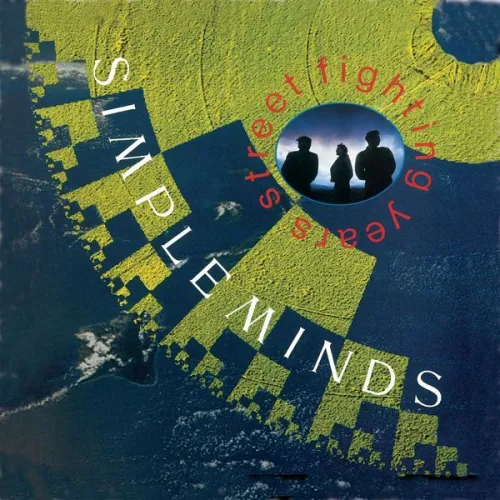
Street Fighting Years is the eighth studio album by the Scottish band Simple Minds, released in May 1989 by Virgin Records internationally and by A&M in the United States. The album marked a significant stylistic shift from its predecessor, Once Upon a Time (1985), moving away from the arena-rock-style soul and gospel that had defined their sound in the mid-1980s. It was produced by Trevor Horn and Stephen Lipson, key figures in British pop at the time, which helped give it an elaborate and atmospheric sound.
On this album, Simple Minds maintained the epic scale of their stadium rock but incorporated a strong layer of soundtrack textures and new acoustic and folk elements, including fretless bass, slide guitar, accordion, and Celtic nuances. This combination resulted in a more contemplative and expansive album, less focused on immediate anthems and more on building moods and long-breathing narratives. Horn and Lipson"s production amplified this approach, with dense arrangements, layers of keyboards, and processed guitars surrounding Jim Kerr"s voice.
Lyrically, Street Fighting Years marked a clear evolution toward overtly political and social themes. Jim Kerr, who had turned 30 at the end of a turbulent decade in British and global politics, directed his lyrics toward issues such as apartheid in South Africa, the conflict in Northern Ireland, Margaret Thatcher"s policies, the Poll Tax, the fall of the Berlin Wall, and the presence of nuclear submarines off the Scottish coast. Kerr himself has noted that he wanted to write about Belfast, apartheid, and Thatcher"s policies, seeking a more mature and committed approach.
This approach is reflected in specific songs. "Mandela Day" was composed at the request of Jerry Dammers to celebrate Nelson Mandela"s 70th birthday (while he was still in prison) and was written and recorded in less than a day, premiering live at the historic tribute concert at Wembley in June 1988. The cover of "Biko," originally by Peter Gabriel, reinforces the focus on apartheid, while the title track "Street Fighting Years" takes a very personal look at the murder of a close friend of the Kerr family in a stabbing incident.
Other songs delve deeper into social and political criticism. "Soul Crying Out" focuses on the policies of the Thatcher government and their social effects, while "Let It All Come Down" takes on a more introspective and meditative tone, characteristic of the album"s reflective nature. "Belfast Child," inspired by a traditional Irish tune, poetically addresses the conflict in Northern Ireland and would become the album"s most iconic single.
The album also includes more energetic, guitar-driven moments that balance out the contemplative nature of the whole. Tracks like "Take a Step Back," "Wall of Love," and "Kick It In" bring a more uptempo vibe and showcase Charlie Burchill’s guitar work, combining the album"s political edge with Simple Minds" tradition of expansive rock. "This Is Your Land" also stands out for featuring a collaboration with Lou Reed, one of the band"s recognized heroes and influences, which fulfilled a "teenage dream" for the group"s members.
Commercially, Street Fighting Years reached number 1 on the UK Albums Chart, cementing Simple Minds" dominance of the charts in the late 1980s. The single "Belfast Child" reached number 1 in the UK, Ireland, and the Netherlands, becoming one of their biggest hits. However, in some markets and among parts of the press, the album was perceived as a less immediate and more "coffee-table" work, due to its length, its somber tone, and its explicit political agenda.
Critical reception was mixed. Some contemporary reviews accused it of rambling and espousing a vague political agenda, while retrospective reviews, such as AllMusic"s, have described it as an artistic and elegant album that may lack instant hooks but rewards the listener with truly beautiful moments. Over time, many fans and commentators have come to regard it as a key work for understanding Simple Minds" maturity and one of their most ambitious albums.
Decades later, the band has revisited the album with special editions and box sets, featuring remastered material and the addition of demos, live recordings, and retrospective notes on the context in which it was created. These reissues have underscored the album"s relevance as a document of an era marked by intense political tensions and have reaffirmed its place as one of the central pieces in Simple Minds" catalog.
History of Simple Minds
Simple Minds is a Scottish rock band formed in Glasgow in 1977, initially from the punk group Johnny & The Self‑Abusers. Following the breakup of that group, the remaining members, led by singer Jim Kerr and guitarist Charlie Burchill, left behind their pseudonyms and strictly punk approach to become Simple Minds, a name taken from a line in David Bowie"s song "The Jean Genie." Their first concerts under this name date back to January 1978 at the Satellite City venue in Glasgow.
During their early years, the band evolved from a punk-influenced sound toward new wave, post-punk, and alternative rock. In the late 1970s and early 1980s, the core of the group solidified as a quintet consisting of Jim Kerr (vocals), Charlie Burchill (guitar), Mick MacNeil (keyboards), Derek Forbes (bass), and Brian McGee (drums). This lineup recorded Simple Minds" first albums, including Life in a Day (1979) and Real to Real Cacophony (1979), which showcased an experimental exploration of new wave.
In the early 1980s, the band refined a more atmospheric and ambitious style, with albums such as Empires and Dance (1980), New Gold Dream (81/82/83/84) (1982), and Sparkle in the Rain (1984). New Gold Dream, in particular, is often considered one of their most accomplished works, featuring an elegant blend of synth-rock and sophisticated pop. During this period, Simple Minds became a leading figure in European alternative rock, with a growing fan base.
Massive success came in the mid-1980s with the album Once Upon a Time (1985), which solidified their stadium rock approach with soul and gospel influences. In 1985, they also achieved global fame thanks to the song "Don"t You (Forget About Me)," associated with the film The Breakfast Club, although this song did not initially appear on any of their studio albums. From then on, Simple Minds became one of the most popular rock bands, filling large venues and topping charts in several countries.
The next chapter of their story is marked precisely by Street Fighting Years (1989), which maintained their dominance on the charts but introduced a strongly political and reflective dimension, as has been described. In the early 1990s, the band continued with albums such as Real Life (1991) and Good News from the Next World (1995), which kept them in the spotlight despite the changing music landscape. However, the second half of the 1990s brought a relative commercial decline.
Throughout their career, Simple Minds has undergone numerous lineup changes, but Jim Kerr and Charlie Burchill have remained the constant core. Notable members at different times include Mick MacNeil (keyboards), Derek Forbes and John Giblin (bass), Brian McGee and Mel Gaynor (drums), among others. This flexibility in lineup has allowed the band to adapt to changes in sound and context without abandoning their core identity.
Starting in the late 2000s, Simple Minds experienced a resurgence in popularity. Albums such as Graffiti Soul (2009), Walk Between Worlds (2018), and Direction of the Heart (2022) returned the band to prominent positions on the charts, especially in the United Kingdom and continental Europe. At the same time, they have maintained a strong live presence, with greatest-hits tours celebrating their extensive career.
According to their official discography, Simple Minds have released more than twenty studio albums, eleven live albums, numerous compilations and box sets, as well as dozens of singles and several videos. Their influence is felt in the development of alternative rock, new wave, and stadium pop, and they continue to be considered one of the most important Scottish bands in rock history. Their ability to combine epic or socially conscious lyrics with expansive arrangements has kept their music relevant for over four decades.
Simple Minds discography (studio albums, according to official discography)
- Life in a Day (1979)
- Real to Real Cacophony (1979)
- Empires and Dance (1980)
- Sons and Fascination/Sister Feelings Call (1981)
- New Gold Dream (81/82/83/84) (1982)
- Sparkle in the Rain (1984)
- Once Upon a Time (1985)
- Street Fighting Years (1989)
- Real Life (1991)
- Good News from the Next World (1995)
- Our Secrets Are the Same (recorded 1999, released 2004)
- Cry (2002)
- Black & White 050505 (2005)
- Graffiti Soul (2009)
- Big Music (2014)
- Acoustic (2016)
- Walk Between Worlds (2018)
- Direction of the Heart (2022)
Street Fighting Years on YouTube
On YouTube, there are playlists and videos that compile Street Fighting Years in its entirety in remastered versions, including all the songs from the album.