The Sirens' Song
The Story of Minstrell in the Gallery
Jetrho Tull
Anderson poured a lot of himself into this album, and it may be his most personal one yet
They say that singing drives away your troubles, and that when you sing, whistle, or hum, it means you’re happy. When I’m feeling good, calm, at peace—in a state you could call happiness—I’ve always, for many years now, hummed, whistled, or recalled a Jethro Tull song. Don’t ask me why, but of all the music I know and like, I always find myself humming Jethro Tull.
I first came across this band in my late teens, and thanks to friends from that time who were older than me, I was able to listen to their entire discography up to the dreadful *Under Wraps* from 1984. 16 albums out of the roughly 30 the band has released to date.
Jethro Tull was an English agronomist and inventor of an original animal-drawn seeding machine, who laid the foundations of modern agriculture and is considered one of the pioneers of the British Agricultural Revolution in the 18th century. This Jethro Tull was born in the county of Berkshire in 1672. He also invented a kind of piano using the pedals of the organ at the parish church where he used to play.
Two hundred and seventy-five years later, in 1947, a composer, singer, guitarist, and flutist named Ian Anderson—founder and leader of the band Jethro Tull—was born in a small town in central Scotland called Dumfermline.
The band’s early days, like all beginnings, were difficult. At age 16, Ian Anderson formed a band with John Evans and Jeffrey (Hammond-Hammond), saving up to buy their first instruments—guitars and drums—all of which were cheap and of poor quality. They called themselves “The Bakes” and played rhythm & blues influenced by the music they listened to, adding saxophone and trumpet. John started playing the organ instead of the drums. Anderson left school and went to art school. Eventually, he gave up painting as well because it lacked the immediacy of music. Anderson was then playing guitar and singing, but he wasn’t good at doing both at the same time, so he decided to focus on just one thing and began singing. They called Mick Abrahams, who lived in a town near London, but since he didn’t want to leave home (even though he was ten years older than the rest of the members) to devote himself entirely to music, the rest of the group moved there. They rented a room with the little money they had because they had cut ties with their parents and had to fend for themselves. They slept on the floor and were often cold and hungry. John immediately started working as a cabinetmaker and mechanic, so the band was left with Mick, Glenn (Cornick), and Anderson. They needed a drummer, and Clive Bunker, a friend of Mick’s, joined them.
Things weren’t going very well for this band, and Anderson started working at a movie theater cleaning the floors. He worked in the mornings, which gave him plenty of time to write songs; he earned 15 pounds a week. They didn’t have a fixed name—“John Evan Band,” “Ian Anderson Pack of Blues,” etc. Any name would do; they had several different ones so they’d get hired again under the assumption they were different bands, and once the deception was discovered, there was no turning back. Back then they were really bad, and no one would book them twice, hence the trick with the names.
Someone from their agent’s office—a history student—suggested the name Jethro Tull, and they landed a contract as the opening act every other Thursday at the Marquee Club in London, which made the name official. They released their first album in 1968, and to this day—with the band still active—they have released some 30 studio albums and sold over sixty million records.
MINSTRELL IN THE GALLERY
In 1970, Britain was in the midst of a major financial crisis with heavy tax burdens; the top income tax rate rose to 83%. Jethro Tull applied for residency in Switzerland in 1972 while recording “A Passion Play,” their sixth album, at the Château d'Herouville in France, to avoid the high tax burden. Nevertheless, they soon returned to Great Britain.
In 1974, the idea of recording abroad arose again, and Anderson took this idea further by enabling the band to record wherever and whenever they wanted without worrying about studio availability.
Inspired by the success of the innovative mobile studio built by the Rolling Stones, Anderson commissioned one for Jethro Tull. Thus was born the “Maison Rouge” mobile studio, designed by Morgan Studios engineer Pete Smith under the supervision of Jethro Tull engineer Robin Black. And so appeared the bright red 8-ton Mercedes truck equipped with high-end studio gear typically found in permanent studios like Morgan Studios. Anderson had the truck parked right outside his house, and good old Ian spent quite a bit of time inside it—so much so that when his youngest son went to school and had to state his father’s profession like the other children, and since he couldn’t quite explain what his father did, he said, “He works in a truck.” “Then he’s a truck driver,” the teacher replied.
“Maison rouge” was ready for use in early 1975, and Minstrell in the gallery is the first album recorded with the mobile studio.
The band chose the French Riviera to record Minstrell in the Gallery in 1975, having learned that there were vacant rooms in the building housing Radio Monte Carlo, the Prince of Wales Hotel, a former palace. The building had four floors, and the radio station used only the first two. The third floor housed a large hall with a gallery overlooking the mezzanine. Long lengths of cable were run from the hall and the gallery down to the “Maison Rouge” truck in the parking lot below, requiring a hole to be cut in the wall of Radio Monte Carlo to allow them to pass through.
They would also record “Too Old to Rock ‘n’ Roll: Too Young to Die!” at these same facilities in 1976.
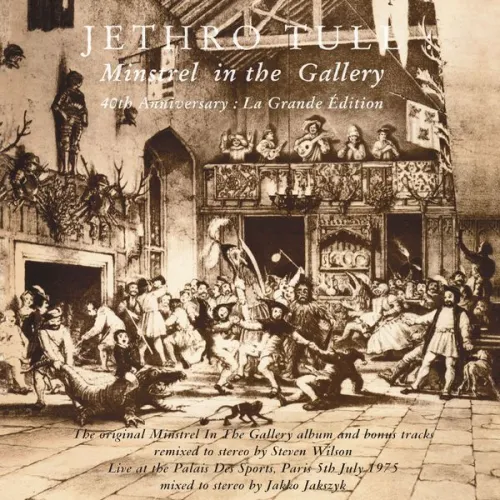
The album cover features a 19th-century engraving by Joseph Nash titled “Twelfth Night Revels” in the great hall of Haddon Hall, Derbyshire, with some minstrels in the gallery overlooking the main hall. The back cover shows the band members in the gallery where they recorded the album, overlooking the hall, at the Monte Carlo studio.
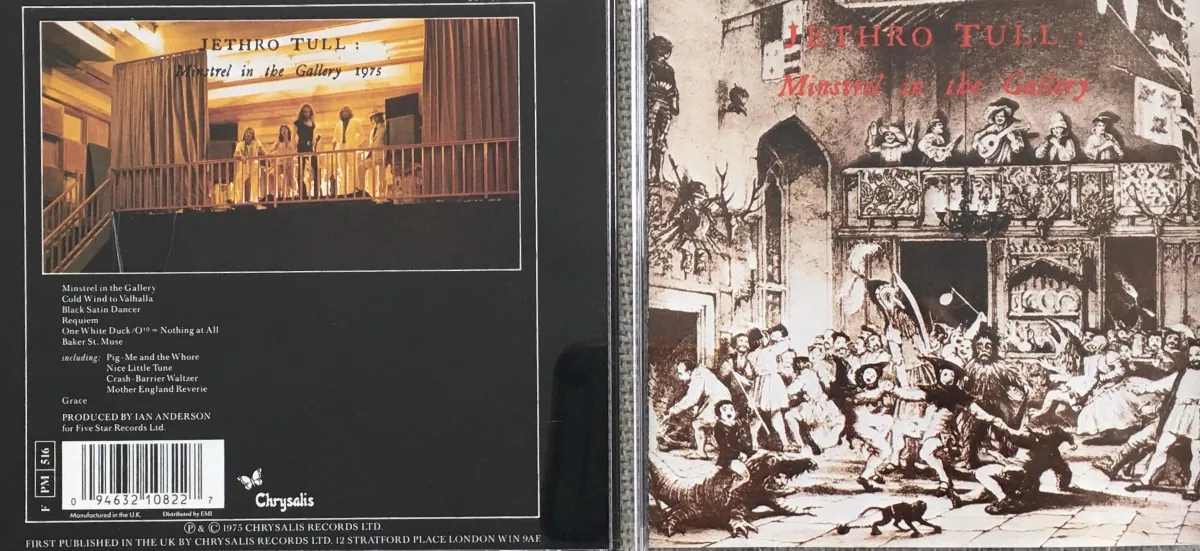
The single was released in August and the album in early September 1975. It reached number 7 in the US and barely made it into the Top 20 in the UK. Reviews at the time were generally positive. Today it is considered one of the band’s best albums, and for fans it ranks among their top three.
It would arrive in Spain later, almost at the same time as the 1971 “Aquallung,” which was banned by censors until 1975. Interestingly, “Minstrell in the gallery” was also released in Spain a little later because four songs were censored, but in the end it was published in its entirety without the censors’ cuts.
• IAN ADERSON: vocals, flute, acoustic guitar, and production.
• MARTIN BARRE: electric guitar.
• BARRIEMORE BARLOW: drums and percussion.
• JOHN EVAN: organ and piano.
• JEFFREY HAMMOND-HAMMOND: bass.
STRINGS:
• Rita Eddowes, Elizabeth Edwards, Patrick Halling, and Bridget Procter, violin.
• Katharine Tullborn, cello.
• David Palmer, orchestral arrangements.
In 2015, a special 40th-anniversary edition was released featuring three versions, with a cleaner sound, greater detail, and a very successful and faithful reproduction of the original recording, with engineer Steven Wilson responsible for the new mix. I have the simplest of the three special editions that were released. This one is identical to the original 1975 version, which I also own, with no bonus tracks. There is another 40th-anniversary edition with bonus tracks, which is the link provided below and is included, like all the reviews, in the Spotify playlist "The Siren Song". And there’s another one called the Grand Edition, which includes 2 CDs and 2 DVDs. All feature the same mastering by Steven Wilson.
Tull usually recorded, as a general rule, all the main parts together as if in a live performance, and then added elements—arrangements, instruments, strings, etc.—until they reached the final version. This album was recorded live in the studio: drums, bass, electric and acoustic guitar, piano/Hammond organ, and vocals were recorded together. Once the band had a take they were happy with, they continued adding overdubs, including percussion, additional guitar lines, backing vocals, flute, and the string section.
On this album, they used the 1745 digital delay, a studio processor capable of taking a single mono source and creating the illusion of stereo and double tracking. It was used extensively on Ian’s guitar and other elements of the mix. A different approach was used with Martin Barre’s electric guitar. The sound from his amplifier was fed into a tape echo, and this delayed signal was recorded on a separate track on the tape, creating the impression of double tracking. In the mix, the clean guitar sound was panned to one side of the stereo image, and the echo signal was panned to the other side. It sounds as if there are two guitars playing, but it is a single performance. This effect is very noticeable on track 2, “Cold Wind to Valhalla”; the high notes play on the right channel, and the delayed signal rises on the left to emphasize them.
For the drums, the two bass drums were recorded on separate channels, the snare on a third channel, and the rest of the kit was recorded together on a stereo pair.
The bass was recorded directly into the mixing console and also from a microphone in front of the speaker cabinet. These two signals were combined and, in the original mixes, panned to one side of the stereo image. This is unusual, as the bass is normally placed in the center of a mix.
This album is the eighth in their discography and introduces strings, as they had done in some previous work where they added orchestral parts wherever they could fit. Here, however, the intention was always for the strings to be a significant part of the finished song. Initially, the arrangements that David Palmer and Anderson had written were for a full orchestra, but the initial recordings with an orchestra in Monte Carlo were disastrous, so they contacted violinist Patrick Halling, who had already collaborated on the album “War Child,” and recruited the female string quartet that had accompanied them for seven months during the album’s tour. The strings were recorded separately over the course of a week.
I believe, and can say without a doubt, that although it is a very acoustic album, it is also the band’s most rock-oriented album, featuring more explosive guitars and drums with overwhelming force. It also features the most tranquil, calm, and acoustic tracks of their entire discography. And all of this is perfectly integrated into the album’s 40-minute runtime. Anderson poured a lot of himself into this album, and it may be the most personal of all; he spent a lot of time composing and rehearsing with the guitar, and there are several tracks where he is the sole performer.
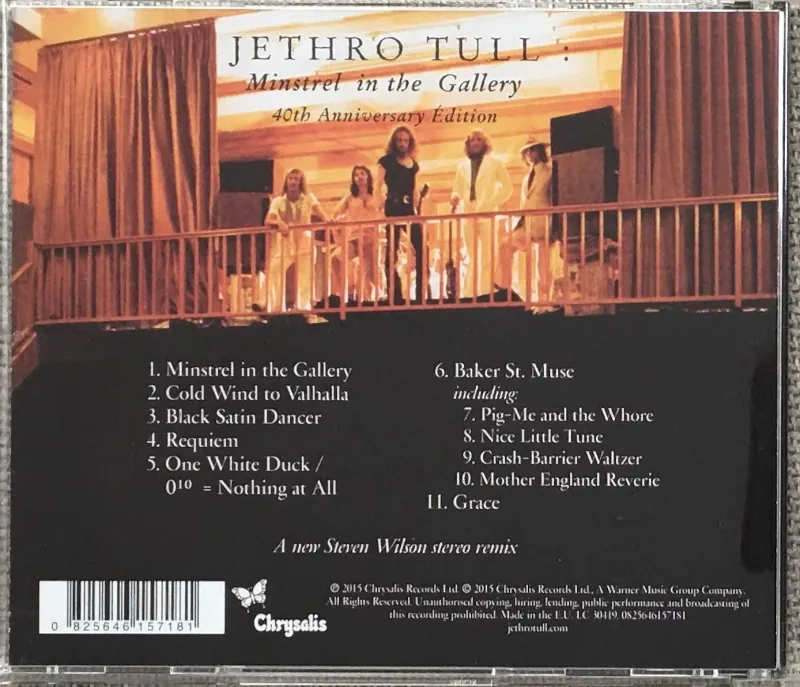
1- MINSTREL IN THE GALLERY, the first track that gives the album its name. Anderson recalls that he may have composed this song during the recording of the album because, at the Monte Carlo studio, they were in a gallery overlooking a larger room below—as if looking out at the audience—and he spent a lot of time there recording guitar and vocals.
For those unfamiliar with the band listening to it for the first time, this opening track will immediately make it clear that nothing sounds the same—that Tull has a sound all its own, distinct and very personal, a blend of folk, rock, classical, symphonic rock, and hard rock. With an almost set formula that starts the songs acoustically before immediately bringing in the heavy artillery—with that double-bass drum and distorted guitar, killer riffs in unison with Anderson’s flute.
2- COLD WIND TO VALHALLA, is based on ancient folklore. In Norse mythology, Valhalla was a vast hall in the afterlife for the fallen, overseen by the god Odin, to which the Valkyries carried the warrior heroes when they died. Great guitar work and especially great drumming. A fantastic track.
3- BLACK SATIN DANCER, according to Ian himself, this is a song of unabashed sexual bravado. A fantasy about a sexy woman in black satin sheets. Pure imagination.
A wild track. It starts and ends very calmly—simulating that roll in the black satin sheets? It could very well be.
It has some beautiful string arrangements. It starts off like a melodic ballad, building up to a climax reached after a sort of waterfall of drum rolls that introduce Martin Barre’s best guitar solo (of his entire discography??), and from there, with Anderson on the flute blowing and screaming, it’s wild until the end, introducing one new track after another.
4- REQUIEM is a requiem for a breakup following the death of a romance, leaving behind the ghost of a failed relationship, in Anderson’s own words. A very beautiful and calm acoustic track—even pastoral—recorded in a single take. Another version featuring piano was recorded and now appears on the 40th-anniversary deluxe edition.
5- ONE WHITE DUCK / 010 = NOTHING AT ALL, two songs intentionally juxtaposed. The first refers to the stereotypical cheesy, cozy, tender, and loving world of the lower-middle-class family environment of the 1950s (what we call kitsch here), and the second part is the polar opposite.
6- BAKER ST MUSE, written around Anderson’s memories and experiences of living in central London, next to Baker Street, enjoying the sights and sounds.
This 16-minute suite in turn contains four tracks (7, 8, 9, and 10) that are perfectly linked and woven together—a hallmark of the band. Tull are specialists at this, shifting between themes with inexhaustible inspiration, creating non-stop music that emulates their great masterpiece “Thick as a Brick”.
Anderson is a great admirer of Bach and a lover of classical music, and he composes in a manner very similar to a classical composer, introducing themes and developing them to move the piece forward, returning from time to time to the main theme. (A sequence might look like this: introduction, presentation of theme 1 and development, theme 2 and development, recapitulation, and final coda.) This song is a clear example of that. To me, it seems like a masterpiece.
7- GRACE, Tull’s shortest song, a song of thanks to end or start the day for what we have received or are about to receive. Acoustic guitar, strings, and vocals to close out this excellent album.
Another take was recorded with just guitar and vocals, which can now be heard on the 40th-anniversary deluxe edition.
To wrap things up, I recommend listening to this fantastic album at a generous volume—one that music critics consider the perfect conclusion to the band’s discography trilogy, alongside “Aquallung” and “Thick as a Brick”. Judge for yourselves and enjoy.



The best music in Hi-Res
Enjoy uncompromising sound quality of this album.
Try it now