History of Hans Zimmer
Hans Zimmer
Hans Zimmer is one of the most influential film composers of the modern era, known for transforming the sound of blockbuster scoring through a blend of orchestral writing, electronic textures, and powerful rhythmic design. Born in Frankfurt, Germany, in 1957, he began his musical life as a keyboard player and self-taught composer rather than through a conventional conservatory path. That background became important to his style, because it helped him approach film music less as a strict academic discipline and more as a living studio craft shaped by experimentation, technology, and collaboration.
Zimmer’s early career developed in Britain, where he worked in bands and studio settings before moving into film and television music. One of the key turning points in his artistic growth was his collaboration with composer Stanley Myers, whose influence helped Zimmer understand how to fuse traditional scoring with newer sonic ideas. During this period, Zimmer learned how to write music that could carry dramatic emotion while also using synthesizers and studio techniques in a way that felt cinematic rather than merely electronic. That combination would become the foundation of his entire career.
His rise to major international recognition came through film work in the late 1980s and early 1990s, especially with scores that brought an energetic modern sound into Hollywood. Rain Man became one of his breakthrough projects, and its success helped establish his reputation for writing music that was emotionally direct yet harmonically distinctive. In the years that followed, he developed a signature approach that often relied on strong ostinatos, layered textures, and bold thematic ideas, giving his scores a sense of momentum and scale that matched the demands of contemporary cinema.
Zimmer’s work in the 1990s and 2000s expanded his reach dramatically. He scored major films across genres, from historical epics and animated features to action films and intimate dramas. His music for The Lion King became one of his most celebrated achievements, combining African musical influences, choral writing, and sweeping emotional arcs in a way that earned both popular admiration and critical respect. At the same time, his action and adventure scores helped define the sound of the modern blockbuster, especially through their use of large-scale sonic architecture, hybrid instrumentation, and thematic repetition that intensifies on-screen tension.
One of the defining features of Zimmer’s career is his collaborative method. Rather than working alone in a traditional composer model, he built a large creative network that included orchestrators, programmers, additional composers, and specialist musicians. This did not reduce his authorship; instead, it allowed him to create a studio-based system capable of producing highly detailed music at a cinematic scale. The result was a body of work that shaped how many later composers and producers thought about film scoring, particularly in high-budget action and science-fiction cinema.
Zimmer’s influence also extended beyond the screen. His concert tours, production company work, and mentorship of younger composers helped spread his aesthetic across a broader musical culture. He became associated with the idea that film music could be both deeply commercial and artistically ambitious, and that electronic design could coexist with orchestral grandeur. His career is therefore not only a story of individual success, but also a story about how the sound of modern cinema changed during the late twentieth and early twenty-first centuries.
By the time he scored Interstellar, Zimmer had already established a reputation for emotional intensity and sonic innovation. That score showed another side of his artistry: a more restrained, contemplative, and almost spiritual form of writing. Instead of relying on constant bombast, he used organ, minimalist repetition, and gradually unfolding harmonic changes to mirror the film’s themes of time, sacrifice, and human endurance. In that sense, Interstellar stands as one of the clearest examples of Zimmer’s ability to adapt his language to the philosophical scale of a film.
Today, Hans Zimmer is regarded not only as a successful composer but also as a major architect of contemporary film sound. His work has helped define what blockbuster music can be, while also proving that large-scale audience appeal and serious musical craft are not mutually exclusive. His history is the history of a composer who understood technology, emotion, and spectacle as parts of the same artistic problem, and who developed a language flexible enough to meet the demands of modern cinema.
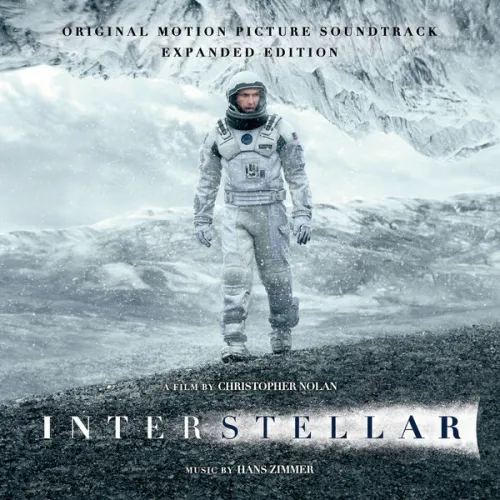
Interstellar
Interstellar is the original motion picture soundtrack composed by Hans Zimmer for Christopher Nolan’s 2014 film of the same name. Although often discussed as a film score rather than a conventional album, it functions as a complete listening experience and is widely treated as one of Zimmer’s most ambitious and emotionally resonant works. The score was created to support a film about time, gravity, sacrifice, and the fragile persistence of human hope, and Zimmer responded by writing music that feels both monumental and intimate.
The score is strongly associated with the sound of the pipe organ, which gives it a vast, sacred, and almost architectural character. Zimmer used the organ not simply for religious symbolism, but because its sustained power and tonal richness could reflect the film’s cosmic scale. The result is a score that feels deeply human while also suggesting the immensity of space. That duality is one of the main reasons Interstellar became so widely admired: it sounds both physically enormous and emotionally vulnerable.
One of the most famous aspects of the score is its gradual, patient structure. Many cues unfold with minimal harmonic movement, but they create enormous emotional impact through layering, pulse, and timbral change. This approach mirrors the film’s concern with time dilation and the vast distances separating the characters from one another. In effect, Zimmer turned the score into a musical representation of relativity itself, where repetition and delay become expressive tools rather than signs of stagnation.
The album has also attracted attention because of the story that Zimmer initially did not know the full science-fiction context of the film when writing early material. This has become one of the most repeated legends around the score, suggesting that the music was born from a more personal emotional concept before being matched to the film’s larger cosmic framework. Whether told as fact or myth, that story has helped deepen the score’s reputation as something mysterious and unusually inspired.
Another reason the score is historically important is its balance between concept and accessibility. It is experimental in its methods, but highly communicative in its emotional effect. Listeners often describe it as one of Zimmer’s most moving works because it avoids constant action cues in favor of weight, patience, and atmosphere. That makes it an especially strong example of how a blockbuster score can also function as a serious musical composition.
Interstellar also occupies a major place within Zimmer’s broader career because it reflects the mature version of his signature style. The score’s large chords, rhythmic surges, and layered textures are unmistakably his, yet here they are used with an uncommon sense of restraint. Instead of overwhelming the film, the music repeatedly opens space for contemplation, which is one reason it has remained so respected among listeners and film music scholars.
As an album, Interstellar stands as a major document of contemporary film scoring. It represents a moment when mainstream cinema and serious musical ambition aligned especially well, and it helped reinforce Zimmer’s status as one of the defining composers of the era. Its enduring appeal comes from the combination of technological sophistication, structural patience, and emotional directness that few composers have matched at the same scale.
Urban Legends
One widely repeated story is that Zimmer wrote material for the score without being told the exact plot of the film, which has led many listeners to believe the music captures pure feeling before narrative detail. Another common legend says that the organ-centered sound was chosen as a kind of secret spiritual symbol, giving the score a deeper metaphysical meaning than the film explains outright.
There is also a persistent belief that Interstellar was one of the scores in which Zimmer pushed himself furthest from conventional Hollywood writing, treating the music more like a philosophical meditation than a normal soundtrack. Whether or not this was his explicit intention, the idea has become part of the album’s mythology and helps explain why it is discussed with such reverence.
Track list
- Dreaming of the Crash — 3:55.
- Cornfield Chase — 2:06.
- Dust — 5:41.
- Day One — 3:19.
- Message from Home — 1:35.
- Stay — 6:52.
- Murph — 4:48.
- Detach — 6:42.
- Running Out — 1:51.
- Tick-Tock — 4:32.
- Where We’re Going — 7:35.
- Organ Variation — 2:01.
- No Need to Come Back — 4:25.
- Imperfect Lock — 6:56.
- What Happens Now? — 2:26.
- Who’s They? — 5:37.
- Murph (Reprise) — 4:40.
- Day One Dark — 2:32.
- Message from Home (Reprise) — 3:20.
- Do Not Go Gentle into That Good Night — 1:39.
Hans Zimmer albums
- Driving Miss Daisy (1989).
- Backdraft (1991).
- The Lion King (1994).
- Crimson Tide (1995).
- Inception (2010).
- Interstellar (2014).
- Dunkirk (2017).
- Wonder Woman 1984 (2020).
- No Time to Die (2021).
- The World of Hans Zimmer - A Symphonic Celebration (2019).


The best music in Hi-Res
Enjoy uncompromising sound quality of this album.
Try it now