The Story of Breakfast In America
Supertramp
Breakfast In America is the sixth studio album by the British band Supertramp, released on March 16, 1979, by A&M Records. It was recorded between May and December 1978 at The Village Recorder studios in Los Angeles, after the group had established itself internationally with previous works such as Crime of the Century and Even in the Quietest Moments... The album marked a clear shift toward a more pop-oriented sound, with more direct and accessible songs, which was reflected in its enormous commercial success worldwide.
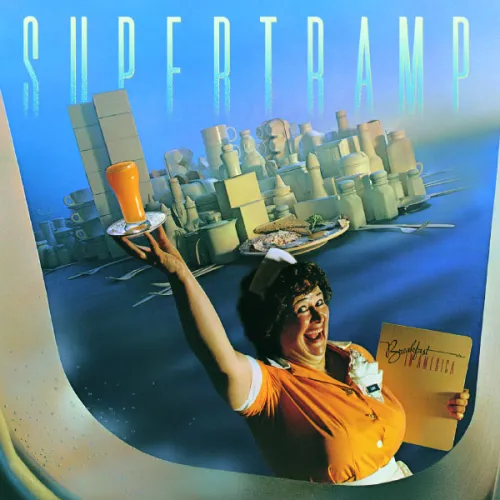
The album cover, one of the most iconic in rock history, features a parody of the New York skyline viewed from an airplane window, replaced by elements of an American diner: skyscrapers made of cereal boxes and other products, and a waitress representing the "Statue of Liberty" holding a glass of orange juice instead of a torch. On the back, the members of Supertramp are seen having breakfast while reading newspapers from their hometowns, reinforcing the visual play between the idea of "breakfast in America" and the British perspective on the American way of life. Years later, some fans linked certain details on the cover to conspiracy theories about 9/11, but this is a later interpretation unrelated to the original intention.
Musically, Breakfast In America is characterized by the prominent use of keyboards (electric piano, Wurlitzer, synthesizers), saxophone, and vocal harmonies, with a very distinct balance between the compositions of Roger Hodgson and Rick Davies. The album opens with "Gone Hollywood" and continues with a sequence of songs that alternate between Hodgson"s more melodic and luminous perspective and Davies"s more ironic and urban approach, creating a contrast that became the band"s trademark. The meticulous production and clarity of the arrangements made the album sound especially good on the radio, contributing to its massive impact.
The album spawned several singles that became rock and pop classics of the late 1970s. "The Logical Song," "Goodbye Stranger," "Take the Long Way Home," and "Breakfast in America" were released as singles and made it into the Top 20 of the Billboard Hot 100 in the United States, establishing the band in the North American market. In particular, "The Logical Song" became one of Supertramp"s best-known tracks, with lyrics about the loss of innocence and alienation in adult life.
In terms of commercial performance, Breakfast In America was the biggest success of Supertramp"s career. The album reached number 3 on the UK charts and hit number 1 in the United States and Canada, remaining in prominent positions for weeks. According to figures from encyclopedic sources, the album sold over four million copies in the United States alone and surpassed twenty million copies worldwide, becoming one of the major commercial milestones in rock music of the era.
The album"s success was accompanied by an extensive world tour, during which Supertramp went from playing small venues to filling large arenas and stadiums. Part of that tour was recorded live and later resulted in the album Paris (1980), recorded at the Pavillon de Paris, which serves as a document of the group at its peak. The Breakfast In America tour cemented the group"s reputation as a band capable of reproducing complex studio arrangements live with great precision.
Over time, Breakfast In America has been widely recognized as one of the key albums of late-1970s rock and pop. It frequently appears on lists of the "best albums" of all time and is considered the high point of Supertramp"s classic era. Its blend of compositional sophistication and melodic accessibility has kept it sounding fresh decades after its release.
History of Supertramp
Supertramp was a British progressive rock and pop rock band formed in 1969 by keyboardist and vocalist Rick Davies. In its early years, the project received financial support from a patron, which allowed for several lineup changes until the band settled into its most stable core lineup with Rick Davies, Roger Hodgson, John Helliwell, Dougie Thomson, and Bob Siebenberg. The band was known for combining elements of progressive rock with more pop-oriented songs, an extensive use of keyboards and saxophone, and the contrast between the vocals and compositional styles of Davies and Hodgson.
Supertramp"s first two albums, Supertramp (1970) and Indelibly Stamped (1971), had limited impact, though they already showed a certain inclination toward experimentation. The big breakthrough came with the classic lineup and the release of Crime of the Century (1974), which is often considered their breakthrough album. This album, featuring songs like "Dreamer" and "School," cemented their reputation in the realm of accessible progressive rock and opened the doors to the international market.
From there, the band continued to evolve with albums such as Crisis? What Crisis? (1975) and Even in the Quietest Moments... (1977), which maintained their sophisticated rock style with an increasingly melodic approach. These albums clearly defined the balance between Hodgson"s brighter, more melodic compositions and Davies"s more urban and ironic ones. This duality became one of the band"s hallmarks.
The high point of their career came with Breakfast In America (1979), as described, which marked their greatest commercial success and placed them at the top of the charts in the United States, Canada, and other countries. Following that album, the band released i...Famous Last Words.../i (1982), an album that, though successful, already reflected the internal tensions between Davies and Hodgson. In 1983, Roger Hodgson left the group to pursue a solo career, marking the end of the classic lineup./p
After Hodgson"s departure, Rick Davies continued to lead Supertramp with new lineups. In the 1980s and 1990s, they released albums such as Brother Where You Bound (1985), which had a more experimental and rock-oriented tone, and Free as a Bird (1987), which was more influenced by the sounds of the era, as well as Some Things Never Change (1997) and Slow Motion (2002). Although these works did not achieve the massive impact of the Breakfast In America era, they kept the band active and on tour.
Throughout their career, Supertramp has sold tens of millions of records worldwide, and their studio discography consists of eleven albums, along with several live recordings and compilations. The band is considered one of the most influential in 1970s rock, particularly for its ability to fuse progressive structures with accessible songs and memorable melodies. Today, their legacy lives on through reissues, compilations, and the role their songs play in popular culture.
Supertramp Discography (Studio Albums and Major Live Albums)
- Supertramp (1970)
- Indelibly Stamped (1971)
- Crime of the Century (1974)
- Crisis? What Crisis? (1975)
- Breakfast in America (1979)
- ...Famous Last Words... (1982)
- Brother Where You Bound (1985)
- Free as a Bird (1987)
- Some Things Never Change (1997)
- Slow Motion (2002)
- Paris (1980, live)
- Live "88 (1988, live)
Breakfast In America on YouTube
There are several videos and playlists on YouTube that compile the entire Breakfast In America album, including remastered versions with all songs in order.