History of Animals
Pink Floyd
Animals is the tenth studio album by the English band Pink Floyd, released on January 21, 1977, by Harvest Records and Columbia Records, after being recorded throughout 1976 at Britannia Row Studios in London, a studio the band had built shortly before. The album continues the tradition of long compositions from previous works such as Meddle (1971) and Wish You Were Here (1975), but marks a significant shift toward a rawer, harder, and openly political sound. Unlike the band’s other albums, Pink Floyd decided not to release singles from Animals, promoting it primarily through the In the Flesh tour, which would later inspire conceptual elements of The Wall (1979).
The album’s origins lie in several compositions the band had been working on since the early 1970s, particularly “You Gotta Be Crazy” and “Raving and Drooling,” which evolved into the extended tracks “Dogs” and “Sheep.” During the sessions at Britannia Row, Roger Waters assumed a dominant role in writing the material: with the exception of “Dogs,” co-written with David Gilmour, all the tracks were composed by him, and the album became Pink Floyd’s first work without songwriting credits for keyboardist Richard Wright. This concentration of creative control in Waters marked a turning point in the group’s internal dynamics and foreshadowed the tensions that would intensify in the following years.
Conceptually, Animals is loosely inspired by George Orwell’s political fable Animal Farm, but rather than focusing on Stalinism, the album directs its criticism at capitalism and the power structures of mid-1970s British society. The lyrics depict different social classes as animal types: dogs represent aggressive, predatory executives; pigs embody despotic and morally corrupt leaders; and sheep symbolize the obedient masses who passively accept their situation until they finally rebel. The album was conceived as a bleak portrait of the social and moral decay of the era, using this animal metaphor to illustrate the dehumanization and structural violence of the system.
Musically, the album is characterized by long instrumental sections, expansive structures, and a more aggressive and raw tone than that of its immediate predecessors. “Dogs,” which occupies most of Side A, combines David Gilmour’s intricate guitar solos with tempo changes, atmospheric passages, and lyrics that dissect the competitive and cynical mindset of the “dogs” of the corporate world. On Side B, “Pigs (Three Different Ones)” offers a satirical and caustic take on specific figures of authority, while “Sheep” chronicles the eventual rebellion of the masses in a crescendo laden with sound effects and ominous keyboards.
The album is framed by the brief acoustic pieces “Pigs on the Wing (Part One)” and “Pigs on the Wing (Part Two),” which open and close the record and lend a more intimate and personal tone. These songs serve as a more emotional commentary, suggesting the importance of human relationships in the face of the harshness of the world described in the rest of the album. In some editions, particularly the 8-track tape version, both parts were combined into a single version featuring an additional guitar solo by Snowy White, but the standard LP structure keeps the two sections separate.
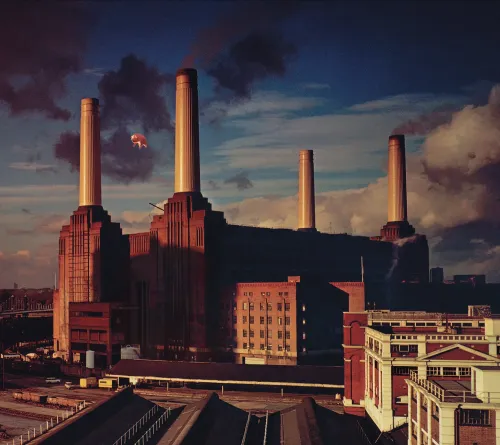
Visually, Animals is famous for its iconic cover featuring an inflatable pig floating among the chimneys of the Battersea Power Station in London, an image designed by the Hipgnosis collective based on an idea by Roger Waters. During the original photo shoot, the pig—nicknamed “Algie”—came loose and soared through the London skies, forcing air traffic to be diverted, an incident that added to the mythology surrounding the album. Decades later, for the release of the i remix Animals 2018 Remix, designer Aubrey “Po” Powell revised the cover with new photographs of the modernized building, maintaining the dark message about moral decay but adapting the image to the contemporary context.
Upon its release, Animals reached number 2 on the UK charts and number 3 in the United States, demonstrating strong commercial performance despite the absence of singles and its dense, conceptual nature. Initial critical reception was mixed, with some reviews deeming the album too somber or less accessible than Wish You Were Here or The Dark Side of the Moon, though others already highlighted its power as a political statement. Over time, the album has been reevaluated very positively and is now considered one of Pink Floyd’s most important and highly regarded works within the progressive rock canon.
The In the Flesh tour, organized to promote the album, involved a considerable stage production and took the band across Europe and North America, but it also highlighted the growing distance between Pink Floyd and their mass audience. Roger Waters, frustrated by the noisy and inattentive behavior of some attendees, was involved in incidents that would later inspire the concept of a wall between artist and audience, an idea that would be fully developed in The Wall. Thus, Animals represents not only a phase of thematic and musical radicalization, but also a key moment in Waters’ personal and creative evolution within the group.
Over the decades, Animals has been recognized as a incisive portrait of the social tensions of the 1970s, whose narrative continues to be relevant in later contexts. The combination of biting lyrics, expansive musical structures, and a powerful visual aesthetic has cemented its status as a cult classic, influencing generations of musicians interested in using progressive rock as a vehicle for social criticism. Recent reissues and remixes, such as the Animals 2018 Remix, have renewed interest in the album, underscoring the enduring relevance of its message and the technical craftsmanship of its original production.
History of Pink Floyd
Pink Floyd is an English rock band formed in London in 1965, recognized as one of the most influential in history both for its pioneering role in psychedelic rock and for its development of progressive rock. The group was founded by Syd Barrett (guitar and vocals), Nick Mason (drums), Roger Waters (bass and vocals), and Richard Wright (keyboards and vocals), who were joined shortly thereafter by David Gilmour (guitar and vocals), completing the classic lineup. In their early days, the group stood out on the London underground scene for their long instrumental improvisations, their spacey atmospheres, and their use of lights and live projections.
The debut album, The Piper at the Gates of Dawn (1967), composed mainly by Syd Barrett, is a seminal work of British psychedelic rock, filled with surreal and experimental songs. However, Barrett’s mental health issues and growing instability, exacerbated by drug use, led the group to gradually sideline him and establish David Gilmour as lead guitarist and co-vocalist. Following his departure, Waters, Gilmour, Wright, and Mason shifted the band’s sound toward more expansive and conceptual forms, exploring the realms of progressive rock and sonic experimentation.
During the first half of the 1970s, Pink Floyd achieved great creative consolidation with a series of albums that expanded their conceptual and sonic ambitions. Albums such as Meddle (1971) and the soundtrack Obscured by Clouds (1972) paved the way for The Dark Side of the Moon (1973), which combined interconnected songs, sound effects, lyrics about the human condition, and meticulous production. The Dark Side of the Moon became one of the best-selling albums of all time and spent years on the charts, cementing the band’s global reputation.
The success continued with Wish You Were Here (1975), an album that reflects on absence, the music industry, and the figure of Syd Barrett, structured around the suite “Shine On You Crazy Diamond.” Next, Pink Floyd delved into a more critical and somber vision of the contemporary world in iAnimals (1977), using animal metaphors to represent different social classes. In 1979, the band released The Wall, an extensive conceptual rock opera centered on the psychological isolation of a rock star, which led to spectacular tours and a film adaptation.
Roger Waters’ growing influence on the band’s artistic and conceptual direction, especially following The Wall and The Final Cut (1983), generated strong internal tensions. Eventually, Waters left the group in the mid-1980s following creative and legal disputes, while David Gilmour and Nick Mason continued the project under the name Pink Floyd, with Wright rejoining as a full member in the later period. This era produced the albums A Momentary Lapse of Reason (1987) and The Division Bell (1994), which sustained commercial interest and led the group back to major world tours.
From the mid-1990s onward, Pink Floyd’s activity decreased significantly, focusing on reissues, compilations, and one-off events. In 2005, the classic lineup of Waters, Gilmour, Wright, and Mason reunited exceptionally for the Live 8 benefit concert in London, a historic milestone for fans. Following Richard Wright’s death in 2008, the band became virtually inactive, although in 2014 they released The Endless River, an album based on recordings from the sessions for The Division Bell that was presented as the definitive conclusion to their studio discography.
Throughout their career, Pink Floyd has sold hundreds of millions of records worldwide and influenced countless artists across diverse genres. They are celebrated not only for their concept albums and studio innovation, but also for their ambitious live shows, which incorporated projections, giant inflatables, complex stage structures, and surround sound. Their legacy rests on a combination of sonic experimentation, thematic depth, and a strong visual dimension, which has made works such as The Dark Side of the Moon, Wish You Were Here, Animals, and The Wall cornerstones of rock history.
Pink Floyd Discography (Studio Albums)
- The Piper at the Gates of Dawn (1967)
- A Saucerful of Secrets (1968)
- More (1969)
- Ummagumma (1969)
- Atom Heart Mother (1970)
- Meddle (1971)
- Obscured by Clouds (1972)
- The Dark Side of the Moon (1973)
- Wish You Were Here (1975)
- Animals (1977)
- The Wall (1979)
- The Final Cut (1983)
- A Momentary Lapse of Reason (1987)
- The Division Bell (1994)
- The Endless River (2014)
Animals on YouTube
On YouTube, there are versions of the full Animals album, including editions featuring the 2018 remix and videos with all the tracks from the original album.