History of Achtung Baby
U2
Achtung Baby is U2’s seventh studio album, released in 1991 and considered one of the most significant turning points in their career. It marked a deliberate break from the epic and overtly political sound they had developed in the 1980s, particularly following The Joshua Tree and Rattle and Hum. The band, tired of their own “stadium rock” image and the criticism they received for their excessive grandiosity, decided to reinvent themselves on all fronts: sound, aesthetics, lyrics, and stage presence.
The process of creating Achtung Baby was complex and marked by internal tensions. The first sessions took place in Berlin, shortly after the fall of the Wall, as the band sought to immerse itself in the atmosphere of change and the city’s experimental tradition. Those initial sessions were difficult: ideas weren’t flowing, there were disagreements over the musical direction, and the band even feared for its survival. However, starting with the seeds of songs like “One,” they found a new creative focus that allowed them to shape the album.
Musically, Achtung Baby incorporated influences from alternative rock, electronic, industrial, and dance music, very much in line with the European scene of the late ’80s and early ’90s. The Edge’s guitars partly abandon the clean brightness of previous albums and become dirtier, more saturated, and processed; the rhythm section embraces darker, more mechanized grooves, and the production utilizes layers of effects, samplers, and textures that were uncommon for U2 up to that point. All of this resulted in a dense, modern, and experimental sound that broke with their previous image.
Lyrically, the album largely abandons the political manifesto tone of the War / The Joshua Tree era to focus on themes of intimacy, relationship crises, faith, doubt, identity, and disillusionment. Bono adopts a more ironic and ambiguous register, both in the lyrics and in his singing style, exploring characters and masks. Songs like “One,” “So Cruel,” and “Love Is Blindness” address breakups and emotional fragility, while “Even Better Than the Real Thing” and “The Fly” play with excess, fame, and the era of media simulation.
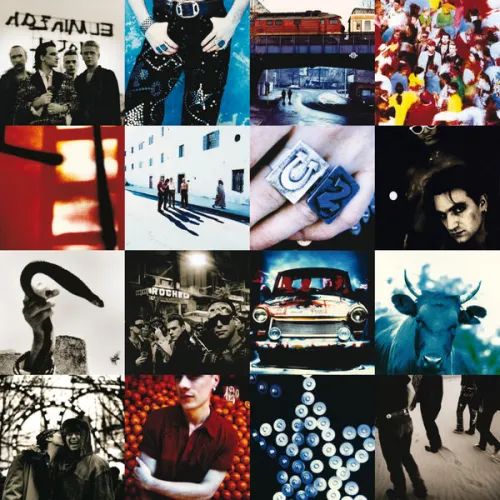
The graphic art and visual aesthetics of Achtung Baby also reflected U2’s reinvention. The cover moves away from the sober imagery of the ’80s and presents a mosaic of photographs, saturated colors, pop symbols, and ironic motifs, underscoring the intention to embrace the culture of channel-surfing and image overload. This aesthetic would be further developed during the Zoo TV tour, where giant screens, ironic messages, and characters like “The Fly” or “MacPhisto” took the critique of the media and the rock star system itself to the extreme.
Critically, Achtung Baby was received as an almost unanimous triumph. The band was praised for taking a risk with a radical stylistic shift—rather than repeating themselves after achieving massive success—without losing their ability to write great songs. Commercially, the album was a global success, with multiple singles charting worldwide and sales in the millions. Over time, it has frequently appeared on lists of the best albums of the 1990s and in rock history, and is considered the beginning of U2’s second major creative phase.
History of U2
U2 is an Irish band formed in Dublin in 1976, consisting of Bono (vocals), The Edge (guitar and keyboards), Adam Clayton (bass), and Larry Mullen Jr. (drums). They met at Mount Temple High School and began playing covers and original songs influenced by punk and post-punk. Their early evolution led them to develop a very distinctive sound, based on The Edge’s atmospheric guitar, Bono’s passionate vocals, and a solid, direct rhythm section.
During the 1980s, U2 went from being a promising post-punk rock band to one of the biggest bands in the world. Albums such as Boy (1980) and October (1981) brought them some notoriety, but it was with War (1983) that they cemented their image as a politically and socially committed group, thanks to songs like “Sunday Bloody Sunday” and “New Year’s Day.” With The Unforgettable Fire (1984) and, especially, The Joshua Tree (1987), they achieved an almost mythical status, combining social commentary, spirituality, and great stadium anthems.
Following the success of Rattle and Hum (1988), which combined a studio album with a documentary about their relationship with American music, the band felt the need to rethink their path. That rethinking led to Achtung Baby (1991) and the experimental phase of the 1990s, which continued with Zooropa (1993) and Pop (1997). During those years, they dabbled in electronic music, techno, trip-hop, and conceptual art, while their tours became massive, self-reflective audiovisual spectacles.
Starting in the 2000s, U2 rebalanced their sound toward a more direct and melodic rock with albums like All That You Can’t Leave Behind (2000) and How to Dismantle an Atomic Bomb (2004), which brought them back to the top of the charts and mainstream radio. Without completely abandoning experimentation, the band focused on writing songs that combined their classic style (stadium anthems, memorable choruses) with the experience accumulated over decades of their career. In the following years, they continued to release albums and embark on world tours with increasingly sophisticated production.
Throughout their career, U2 has been recognized with numerous Grammy Awards and other accolades, and has maintained a constant presence in social and political debates, from foreign debt and AIDS in Africa to human rights causes. Their ability to reinvent themselves at key moments, as they did with Achtung Baby, has been fundamental to their artistic longevity. Today they are considered one of the most influential and important bands in contemporary rock, with a legacy that spans several generations of listeners.
Songs from Achtung Baby with durations
- Zoo Station – 4:36
- Even Better Than the Real Thing – 3:41
- One – 4:36
- Until the End of the World – 4:39
- Who’s Gonna Ride Your Wild Horses – 5:16
- So Cruel – 5:49
- The Fly – 4:29
- Mysterious Ways – 4:04
- Tryin’ to Throw Your Arms Around the World – 3:53
- Ultra Violet (Light My Way) – 5:31
- Acrobat – 4:30
- Love Is Blindness – 4:23
U2 Discography (Studio Albums)
- Boy (1980)
- October (1981)
- War (1983)
- The Unforgettable Fire (1984)
- The Joshua Tree (1987)
- Rattle and Hum (1988)
- Achtung Baby (1991)
- Zooropa (1993)
- Pop (1997)
- All That You Can’t Leave Behind (2000)
- How to Dismantle an Atomic Bomb (2004)
- No Line on the Horizon (2009)
- Songs of Innocence (2014)
- Songs of Experience (2017)